


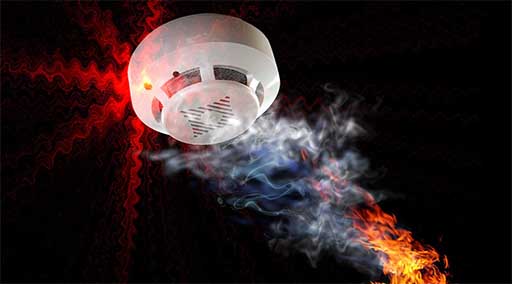
Water Mist Detectors (sensors) are one of the main components of fire alarm systems that are responsible for detecting the presence of fire, smoke, heat or certain gases. These sensors send information to control systems and ultimately activate alarms and other safety equipment.
1. Smoke Detectors:
• Definition: Smoke detectors are designed to detect smoke from a fire. They quickly detect smoke and send a warning signal.
• Types of Smoke Detectors:
1. Ionization Smoke Detectors:
• How it works: These detectors work by using a flow of ions in a small chamber. When smoke enters the room, the flow of ions is disrupted and this change activates the detector.
• Advantages: High sensitivity to dilute smoke, suitable for detecting fast fires.
• Disadvantages: Less sensitive to smoke from slower fires (such as wood or furniture fires).
2. Photoelectric Smoke Detectors:
• How they work: These detectors use a beam of light that is shone from a bulb onto a sensor. When smoke enters the device, it scatters the light, which triggers the detector.
• Pros: Highly sensitive to smoke from slower, slower fires.
• Cons: Less sensitive to fast, high-flame fires.
3. Dual-Sensor Smoke Detectors:
• How they work: These detectors use a combination of ionization and photoelectric detectors, so they are more sensitive to different types of fires.
• Pros: Highly sensitive to different types of smoke.
• Cons: May be more expensive.
2. Heat Detectors Detectors):
• Definition: Heat detectors are designed to detect the increase in temperature and heat caused by a fire. These detectors can detect sudden changes in temperature.
• Types of Heat Detectors:
1. Fixed Temperature Heat Detectors:
• How they work: These detectors are activated when the temperature exceeds a certain level. This is usually between 50 and 75 degrees Celsius.
• Advantages: Suitable for spaces where there is little possibility of smoke spreading.
• Disadvantages: They may not respond to a fire very quickly.
2. Rate-of-Rise Heat Detectors:
• How they work: These detectors are activated when the rate of temperature rise exceeds a certain level, in other words, when the rate of heating of the environment is very rapid.
• Advantages: High sensitivity to fast and blazing fires.
• Disadvantages: Sensitivity may be low in places where the temperature naturally rises
3. Combination Smoke and Heat Detectors:
• Definition: These detectors use a combination of two types of smoke detectors and heat detectors to detect smoke and heat simultaneously.
• Advantages: These detectors are more accurate and practical than single-sensor systems
• Disadvantages: Higher cost and complexity of installation.
4. Gas Detectors:
• Definition: Gas detectors detect specific gases produced by a fire. These systems are usually used to detect CO (carbon monoxide), CO2 (carbon dioxide), and methane.
• Types of Gas Detectors:
1. Carbon Monoxide Detectors:
• How They Work: These detectors are designed to detect CO (carbon monoxide), which is one of the toxic gases produced by fire.
• Advantages: Very useful for detecting fires in places where smoke cannot easily spread.
2. Carbon Dioxide Detectors (CO2 Detectors):
• How it works: These detectors are designed to detect the increase in CO2 levels caused by fire and combustion. 5. Acoustic Detectors: • Definition: Acoustic detectors are designed to detect the sound of an explosion or the sound of a fire.
• Advantages: These types of detectors can help detect large fires that are loud.
How detectors work:
1. Fire detection: Detectors detect fire through smoke, heat, or gases.
2. Sending a signal to the central panel: After detecting a fire, a signal is sent to the control panel, which sends information to the alarm systems and fire extinguishing systems.
3. Alerting residents or authorities: Then Upon detection of fire, siren or alarm systems are activated to inform people of the danger of fire. Official sources and standards: 1. NFPA (National Fire Protection Association): Standards such as NFPA 72 that relate to fire alarm systems.


No comments